

MENU

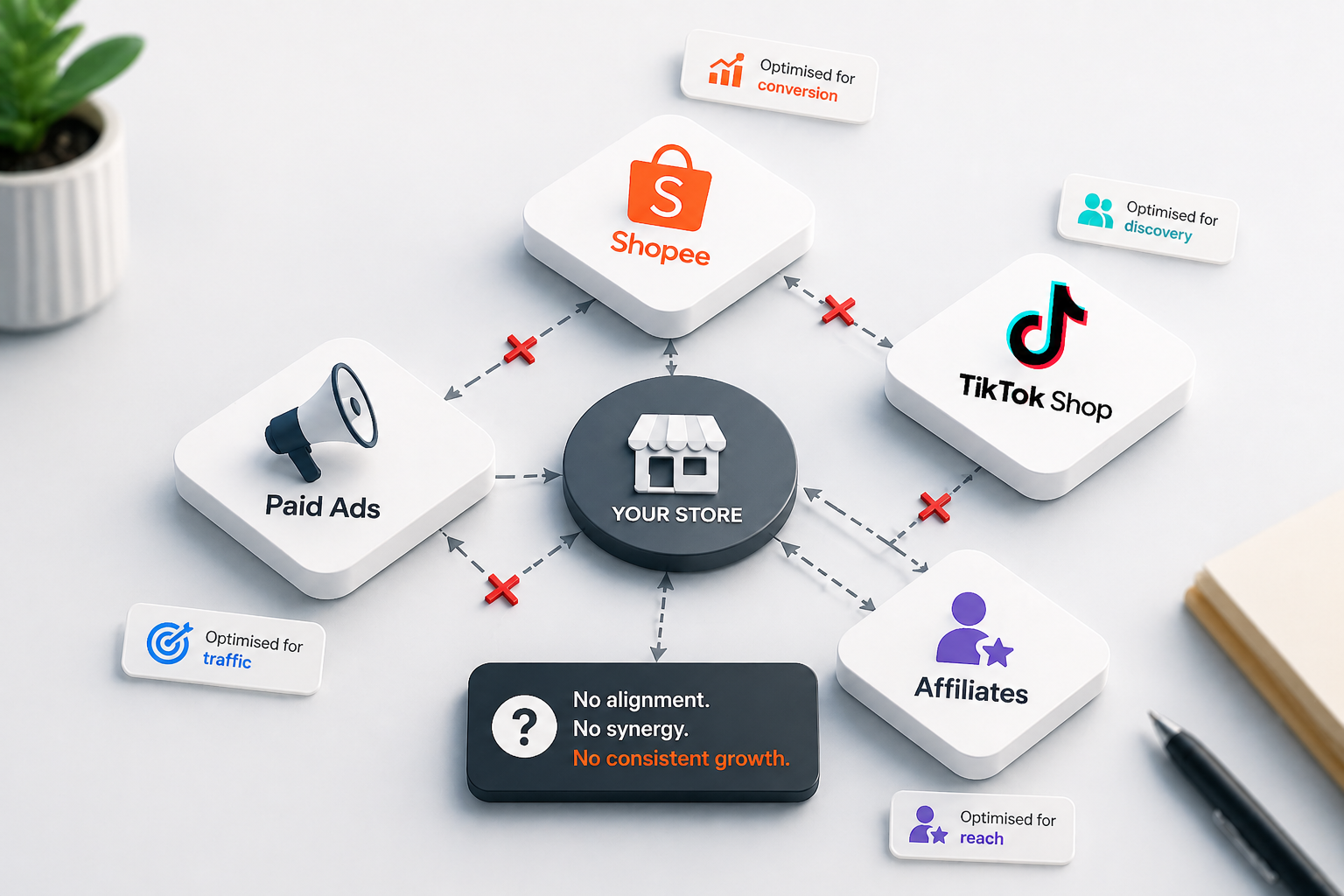
Running on multiple platforms is not the problem. Treating them independently is. This article explains why fragmented channel strategies limit growth, even when each platform appears to perform.
Most ecommerce brands in Malaysia today are not lacking in channels. In fact, they are present on more platforms than ever before. Shopee, TikTok Shop, paid media, affiliates, and brand websites all form part of the typical setup. Each channel is active, each team is working, and each platform shows some level of performance.
Yet despite this level of activity, many businesses struggle to scale consistently.
Sales fluctuate. Campaign results feel unpredictable. Performance improves in one area, only to drop in another. Over time, it becomes difficult to tell what is actually driving growth and what is simply reacting to short-term efforts.
This is not because the platforms are ineffective. It is because they are rarely designed to work together.
Shopee focuses on conversion through pricing, vouchers, and visibility within the marketplace. TikTok prioritises content-driven discovery and impulse-driven purchases. Paid media is structured around targeting, traffic generation, and performance metrics. Affiliate strategies depend on creator reach and incentive alignment.
Individually, each of these channels has a clear role. The issue is that most businesses manage them independently.
Different teams or vendors handle different platforms. Each one works towards its own targets, using its own metrics, and optimising based on its own logic. What looks like a diversified strategy is often a collection of disconnected efforts.
As a result, there is no unified direction guiding how these channels should interact.
When platforms are treated separately, growth becomes fragmented.
A strong TikTok campaign may drive traffic, but if the product positioning is inconsistent on Shopee, conversion suffers. Paid ads may bring in high-intent users, but if the website does not clearly guide decisions, those users drop off. Affiliate content may create awareness, but without alignment to pricing or availability, the impact is diluted.
Each channel contributes something, but the overall effect is less than the sum of its parts.
This is where many ecommerce brands start to feel that they are “doing everything” but not seeing proportional results.
Adding more channels is often seen as a way to accelerate growth. In practice, it can increase complexity faster than it increases returns.
Every additional platform introduces new variables — new data, new formats, new optimisation requirements. Without a clear structure, this complexity becomes difficult to manage.
Instead of reinforcing each other, channels begin to compete. Budget is shifted based on short-term performance. Campaigns are adjusted without considering the broader impact. Decisions are made reactively rather than strategically.
Over time, this leads to inefficiencies that are difficult to identify, because no single channel appears to be failing outright.
The issue is not the number of platforms. It is the lack of clarity in how each platform contributes to growth.
In a structured ecommerce system, every channel has a defined role.
Some channels are responsible for discovery. Others for consideration. Others for conversion. Some are designed to drive immediate revenue, while others build long-term demand.
More importantly, these roles are connected. What happens on TikTok should influence how products are presented on Shopee. What is communicated in ads should be consistent with how the product is described on the website. Pricing, messaging, and positioning should reinforce each other across all touchpoints.
When these elements are aligned, the system becomes more efficient. Each channel supports the others, and the overall impact is amplified.
Most ecommerce teams in Malaysia are structured around execution. They are tasked with running campaigns, managing platforms, and hitting performance targets. While these are necessary functions, they do not address how the system itself is designed.
Without a clear framework guiding how channels should work together, execution becomes reactive. Teams optimise based on immediate results rather than long-term structure. Vendors focus on delivering within their scope, without visibility into the broader ecosystem.
This is why even strong execution can fail to produce consistent growth.
The issue is not how well each part is run. It is how well the parts are connected.
Instead of asking which channel to invest in next, the more useful question is how your current channels are meant to function together.
What role does each platform play? How does traffic flow between them? How is product positioning maintained consistently across environments? Where does decision-making become unclear for the customer?
Answering these questions requires stepping back from individual platforms and looking at the system as a whole.
At INTEGRATED, we do not treat Shopee, TikTok, ads, or affiliates as separate initiatives. We look at how they operate collectively as part of a single ecommerce system.
This involves defining the role of each channel, aligning messaging and positioning across platforms, and ensuring that every touchpoint contributes to a consistent decision journey.
Rather than optimising individual channels in isolation, the focus is on how the entire system can be structured to support scalable growth.
This reflects our role as a consultancy — designing and governing how different parts of your marketing ecosystem work together, rather than simply executing within them .
Ecommerce growth does not come from being present on more platforms. It comes from understanding how those platforms work together.
Shopee, TikTok, ads, and affiliates are all powerful in their own right. But when treated separately, they create complexity without clarity.
The brands that scale effectively are not necessarily using more channels. They are using them with greater alignment.
If your ecommerce business is active across multiple platforms but still struggling to scale consistently, it may be time to reassess how those channels are structured.
Start with an ecommerce audit by INTEGRATED to identify where fragmentation is limiting your growth and how your system can be aligned for better results.
Explore Real Strategies, Trends, and Tips to Help Your Brand Grow.


